






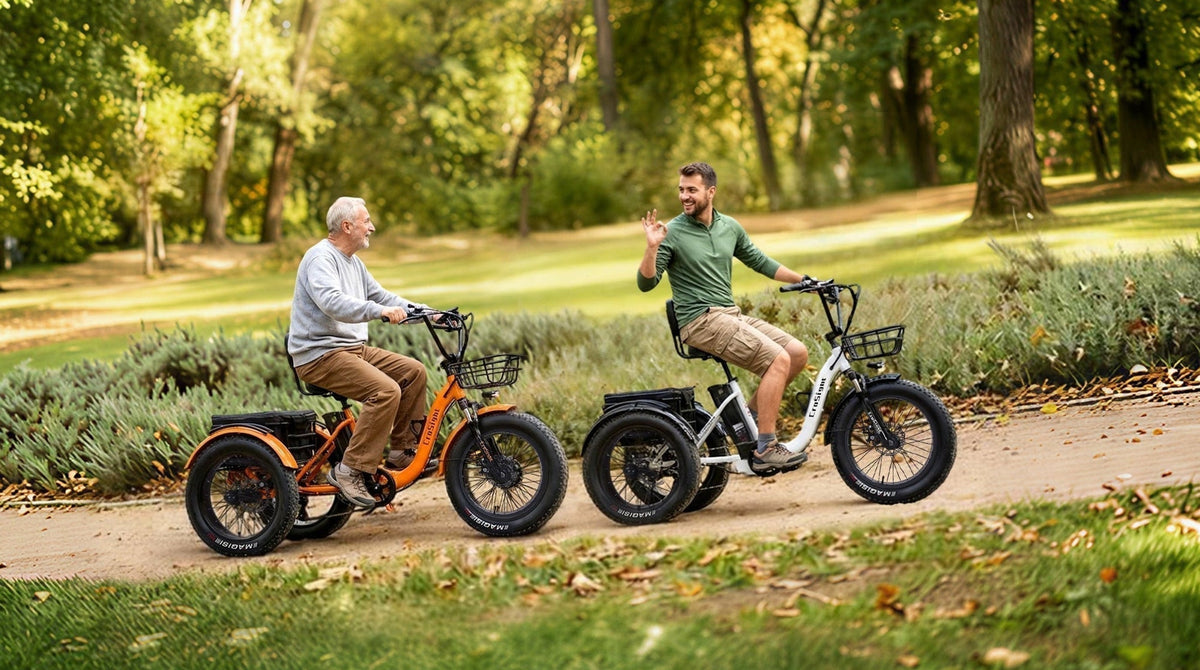
Electric tricycles have made cycling accessible to a much wider range of riders. People who once felt unsure about balancing on a traditional bicycle can now ride with greater confidence, enjoying the comfort, stability, and practicality that three wheels provide. From seniors rediscovering outdoor mobility to riders with limited balance or knee discomfort, electric trikes offer a sense of freedom that two-wheel bikes often cannot.
However, even with these advantages, many riders notice something unexpected when they begin riding: turning can sometimes feel less smooth than anticipated. Some experience slight leaning, resistance in the steering, or the need to slow down significantly before making a turn. While it’s easy to assume this is simply part of riding a trike, the reality is that this feeling often comes down to one overlooked but essential component—the differential.

On many basic electric tricycles, the rear wheels are designed to rotate at the same speed at all times. This may seem efficient, but it doesn’t reflect how a vehicle naturally moves when turning.
In any turn, the outer wheel needs to travel a longer path than the inner wheel, which means it must rotate faster. When both wheels are forced to move at the same speed, the trike begins to resist the turn, creating a dragging sensation that can lead to tire friction, reduced control, and an overall unstable feeling. This is why some riders describe their trike as feeling stiff or awkward when cornering.
A differential solves this problem by allowing each rear wheel to rotate independently, automatically adjusting speed based on the path of the turn. The result is a smoother, more natural riding experience that feels intuitive rather than forced.
Once you ride an electric tricycle equipped with a differential, the improvement becomes immediately noticeable.
Turning feels fluid and controlled, without the sense of the vehicle being pulled or restricted. The trike responds more naturally to steering input, and the rider no longer needs to overcompensate or drastically reduce speed just to maintain stability.
This becomes even more important when carrying cargo or riding at a steady pace. The differential helps reduce unnecessary strain on the tires, axle, and other mechanical components, allowing everything to work more smoothly together. Without it, repeated dragging during turns can accelerate wear and reduce the lifespan of key parts. With it, the entire system operates more efficiently, improving both durability and comfort.

Because of the three-wheel structure, electric tricycles inherently deal with uneven forces during turns. This makes the role of a differential even more critical.
For riders who value safety, predictability, and ease of use—especially seniors or those with limited mobility—a smoother turning experience directly translates into greater confidence on the road.
When choosing an electric tricycle, it’s common to focus on visible features like motor power, battery range, or overall design. However, the true riding experience is often defined by the components you don’t immediately see.
A differential is one of those hidden elements that plays a decisive role in how safe, smooth, and comfortable your ride feels.

If you’re looking for an electric trike that offers not only stability at rest but also confidence in motion—especially when turning—then choosing a model equipped with a differential is one of the smartest decisions you can make.
Models like the CroSight 2.0 Pro are designed with this in mind, integrating a differential into the rear drive system to ensure that handling remains stable and natural in real-world riding conditions. Combined with a well-balanced frame and thoughtful engineering, this creates a trike that feels steady not just when riding straight, but through every turn.


1 comentario
Nancy
Do these 3wheel tricks have throdal assist
Dejar un comentario
Este sitio está protegido por hCaptcha y se aplican la Política de privacidad de hCaptcha y los Términos del servicio.